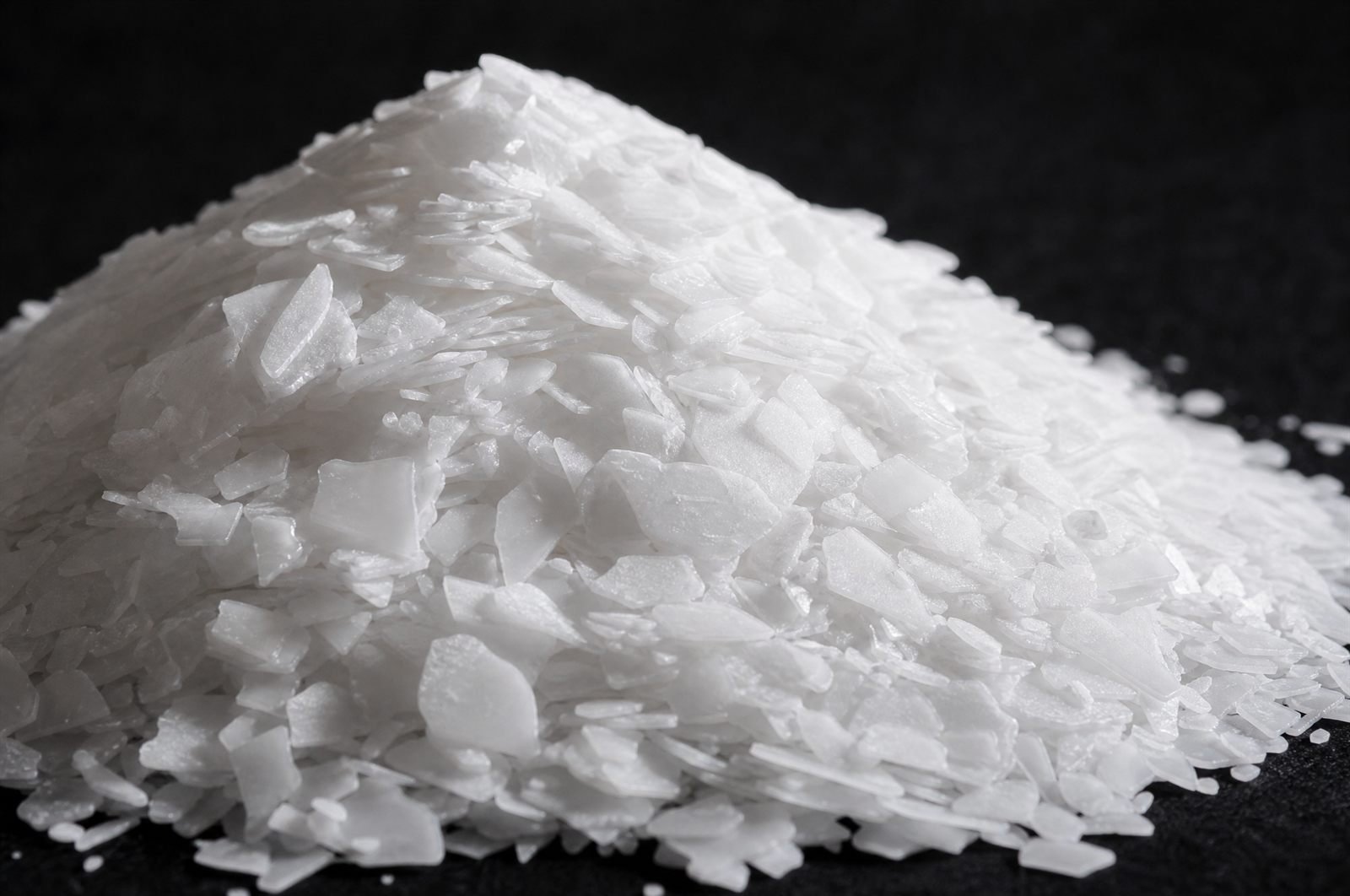
Caustic Soda
Caustic soda is the alkali most of our silicate customers also buy, so we stock it in both solid and liquid form. Flakes suit batch work and smaller plants; lye suits continuous dosing and high-volume users with tank storage.
Where your process is iron-sensitive, such as textile mercerising or a light-coloured soap, specify it and we will pick stock against the tighter Fe limit.
Technical specifications
Flakes
NaOH 98% min · HSN 2815 11 00- Sodium hydroxide (NaOH)98.0% min
- Sodium carbonate (Na₂CO₃)1.5% max
- Sodium chloride (NaCl)0.15% max
- Ferric oxide (Fe₂O₃)0.01% max
- Moisture1.0% max
- AppearanceWhite flakes, deliquescent
Lye (solution)
NaOH 47–49% · HSN 2815 12 00- Sodium hydroxide (NaOH)47.0–49.0%
- Sodium carbonate (Na₂CO₃)0.3% max
- Sodium chloride (NaCl)0.02% max
- Iron (as Fe)5 ppm max
- Specific gravity @ 30°C1.48–1.52
- AppearanceClear colourless liquid
Figures are typical and non-binding. A certificate of analysis is issued with every consignment.
Packing options
- HDPE bag (flakes)25 kg / 50 kg
- Jumbo bag (flakes)1 MT
- HDPE drum (lye)250 kg
- Bulk tanker (lye)20 – 25 MT
Caustic soda is strongly corrosive and flakes are deliquescent. Store sealed and dry, away from acids and aluminium, and handle with appropriate PPE.
Applications
Selection notes
Flakes are easier to store, need no tank and carry no freight-on-water penalty. Right for batch plants and lower monthly volumes.
Lye removes the dissolving step along with the heat and dust it generates. Right for continuous processes, but you need bunded tank storage and corrosion-rated lines.
Iron matters more than assay for many buyers. Two lots can both read 98% and behave differently in a light-coloured product. If colour is critical, ask for the Fe figure, not just the assay.
Safe handling
Always add caustic to water, never water to caustic
Dissolving caustic soda is strongly exothermic. Adding water to solid caustic can flash the water to steam and eject hot alkali from the vessel. Add flakes slowly to water with agitation, and allow for the temperature rise.
It causes deep burns
Unlike most acids, caustic burns are initially painless and continue penetrating tissue. Face shield, chemical gloves and apron are the minimum. An eyewash and safety shower must be within reach of any decanting point.
Not with aluminium
Caustic reacts with aluminium, zinc and tin, generating hydrogen. Never store or transfer it in aluminium vessels or fittings.
Storage
Flakes are deliquescent
Exposed flakes absorb atmospheric moisture and carbon dioxide, turning sticky and converting to carbonate at the surface. Keep bags sealed and use opened bags promptly.
Lye can crystallise in cold
At around 48–50% concentration the solution begins to drop crystals as temperature falls. Where winter temperatures are low, tanks and lines need lagging or trace heating.
Mild steel is fine, at ambient
Carbon steel is the standard material for caustic storage at ambient temperature. At elevated temperature stress corrosion cracking becomes a consideration.
Common questions
Should I add caustic soda to water or water to caustic soda?
Always add caustic to water, slowly and with agitation. Dissolving is strongly exothermic, and adding water to solid caustic can flash it to steam and eject hot alkali from the vessel.
What is the difference between caustic soda flakes and lye?
They are the same chemical in different forms. Flakes are solid NaOH at 98% minimum, easy to store and suited to batch use. Lye is a 47-49% solution that removes the dissolving step but needs bunded tank storage and corrosion-rated lines.
Can caustic soda be stored in aluminium containers?
No. Caustic reacts with aluminium, zinc and tin and generates hydrogen. Use carbon steel or an approved plastic at ambient temperature.
Why does caustic soda lye crystallise in winter?
At around 48 to 50 percent concentration the solution starts dropping crystals as temperature falls. Lag or trace-heat tanks and lines where winter temperatures are low.