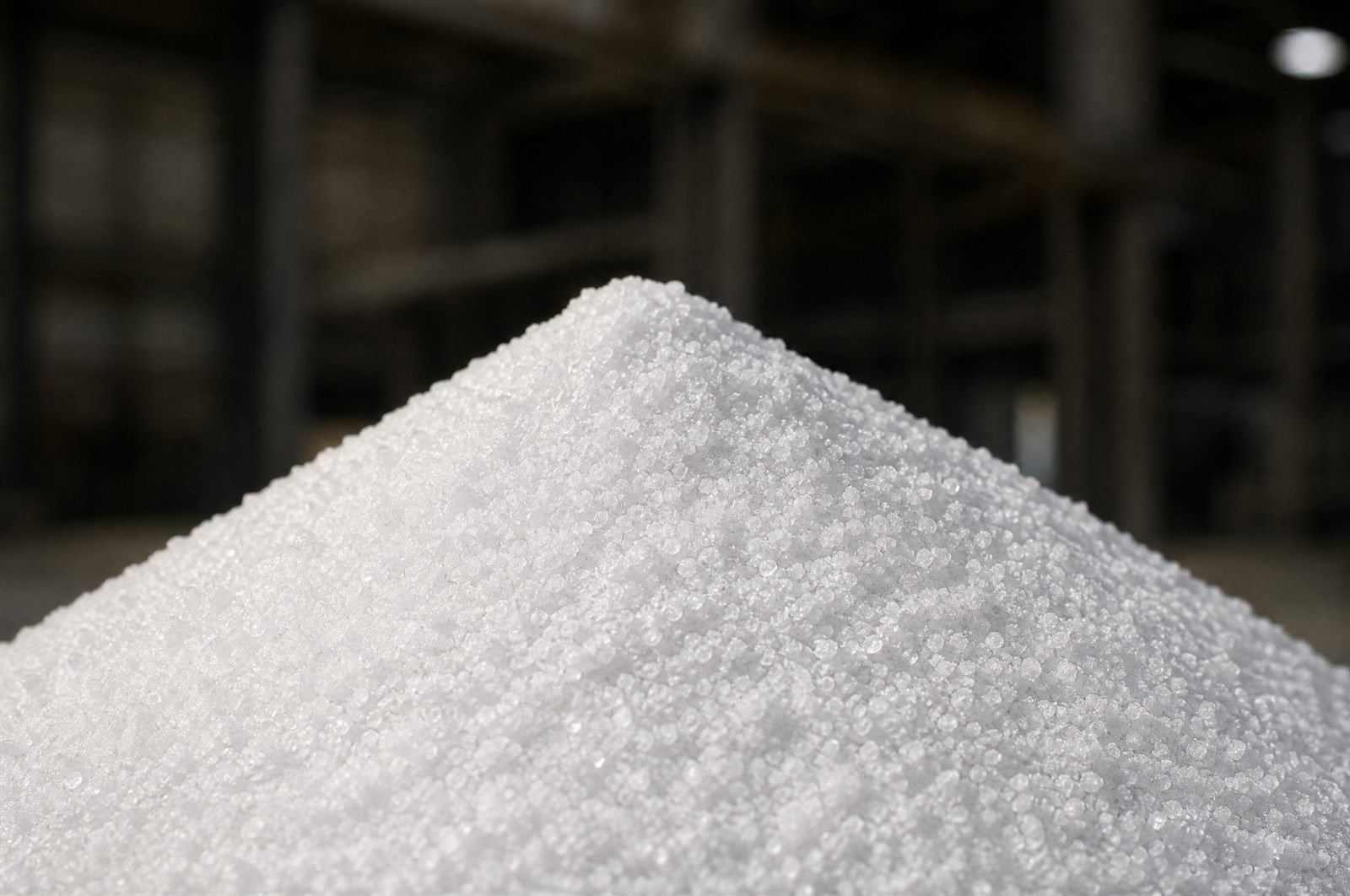
Soda Ash
We import soda ash and hold it in stock alongside the silicate we manufacture. It is the same material we feed into our own furnace, so the grade we sell is the grade we rely on.
Both dense and light grades are available. The chemistry is identical; the difference is bulk density and particle size, which decides how the material handles in your batch house or blender.
Technical specifications
Dense grade
Bulk density 1000–1200 kg/m³- Na₂CO₃ (as anhydrous)99.2% min
- Sodium chloride (NaCl)0.5% max
- Iron (Fe)35 ppm max
- Water insolubles0.05% max
- Loss on ignition0.5% max
- +100 mesh retention85% min
Light grade
Bulk density 500–600 kg/m³- Na₂CO₃ (as anhydrous)99.2% min
- Sodium chloride (NaCl)0.6% max
- Iron (Fe)35 ppm max
- Water insolubles0.05% max
- Loss on ignition0.5% max
- AppearanceWhite free-flowing powder
Figures are typical and non-binding. A certificate of analysis is issued with every consignment.
Packing options
- HDPE / paper bag50 kg
- Jumbo bag1 MT
- BulkTanker / container
- Export packingTo order
Soda ash is hygroscopic. Store under cover on pallets and keep bags sealed until use.
Applications
Selection notes
Dense grade flows and meters cleanly, produces less dust and is the standard choice for glass batch houses and automated dosing lines.
Light grade dissolves faster and blends more readily into powders. Preferred in detergent and chemical formulation where dissolution rate matters more than flow.
On import we hold buffer stock rather than shipping against each order, so lead times do not track the shipping cycle. Ask for current availability before you plan a run.
Handling & storage
Hygroscopic and prone to caking
Soda ash picks up moisture and carbon dioxide from air, forming lumps and eventually a hard cake. Store bags sealed, under cover, on pallets off the floor. In a humid coastal warehouse this is the difference between free-flowing product and a bag you have to break up with a bar.
Stock rotation
First in, first out. Long-stored ash that has picked up moisture will still assay well but handles badly in automated dosing.
Mildly alkaline
Not aggressive like caustic, but the dust irritates eyes and airways. Use dust extraction at tipping points and a mask when charging by hand.
Choosing between grades
Bulk density is the decision
Dense grade at roughly 1000–1200 kg/m³ flows and meters cleanly and generates less dust. Light grade at 500–600 kg/m³ dissolves faster and blends more readily into powder formulations.
Glass makers take dense
Batch houses run automated weighing, so flow and consistency matter more than dissolution rate. Detergent and chemical formulators more often take light.
Common questions
What is the difference between dense and light soda ash?
Chemically they are identical sodium carbonate. The difference is bulk density and particle size. Dense (1000-1200 kg/m3) flows and meters cleanly for glass batch houses and automated dosing. Light (500-600 kg/m3) dissolves faster and blends better into powders.
Why does soda ash cake in storage?
It absorbs moisture and carbon dioxide from the air. Keep bags sealed, store under cover on pallets off the floor, and rotate stock first-in-first-out.
Is soda ash the same as caustic soda?
No. Soda ash is sodium carbonate (Na2CO3), a mild alkali. Caustic soda is sodium hydroxide (NaOH), far stronger and corrosive. They are not interchangeable.